Marans vs Welsummer: Which Dark Egg Layer Is Better?
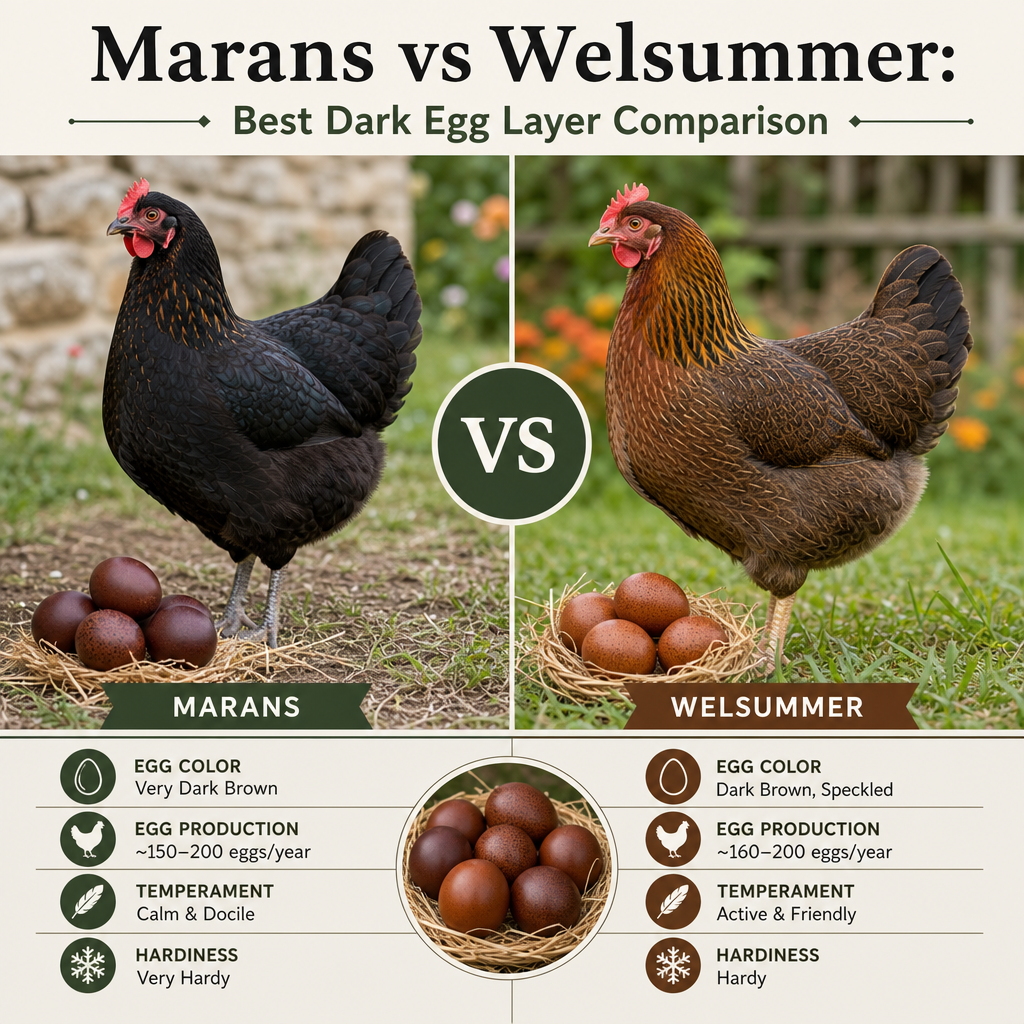
When people start looking for dark egg layers, two breeds almost always rise to the top of the list: Marans and Welsummer. Both are well-known for producing brown eggs that are deeper in color than standard brown layers, and both are attractive, practical birds for backyard flocks. Yet they are not interchangeable breeds. They differ in egg color consistency, temperament, body type, productivity, broodiness, climate tolerance, and breeding complexity.
For keepers trying to decide between Marans vs Welsummer, the best choice depends on what matters most. If the goal is the deepest possible egg color and a classic “chocolate egg” look, Marans usually have the edge. If the goal is a reliable, active, attractive layer of terracotta-to-dark brown eggs with easier management and strong foraging ability, Welsummers often make more sense.
A meaningful comparison requires more than simply asking which breed lays darker eggs. It helps to understand how egg color works, why strains matter, and how each breed performs in a real backyard or small-farm setting.
Understanding “Dark Egg Layers”
The phrase dark egg layers is often used loosely, but in poultry terms it usually refers to hens that lay eggs significantly darker than the medium-brown eggs produced by common utility breeds such as Rhode Island Reds or Barred Rocks.
The dark brown eggs seen in Marans and Welsummers result from pigment deposited on the shell late in the egg formation process. The main pigment involved is protoporphyrin, which creates the brown surface coloration. Unlike blue eggs, where pigment is integrated through the shell structure, dark brown coloring is largely a surface coating. That is why dark eggs can sometimes show rub marks, speckling, or lighter areas.
Several factors affect egg darkness:
Genetics
Genetics determine the hen’s potential for shell color. This is why strain selection matters so much, especially in Marans.
Age of the Hen
Pullets often lay their darkest eggs at the beginning of a laying cycle. Over time, eggs may become lighter, especially during periods of heavy production.
Stage of the Laying Season
Egg color often starts darker after a break in laying, such as after molt or winter slowdown, then gradually lightens as the cycle continues.
Stress and Nutrition
Nutrition and flock management influence overall egg quality, although they cannot turn a genetically average layer into an elite dark egg layer.
Understanding these points is essential because many people expect every egg from every Marans or Welsummer hen to remain uniformly dark all year. In reality, both breeds can produce variation, though Marans are generally bred with a stronger emphasis on exceptional shell darkness.
Breed Origins and Background
Marans
The Marans chicken originated in the town of Marans in western France. The breed developed a reputation for rich dark brown eggs and a dual-purpose body. Marans gained international attention largely because of those famously dark eggs, often described as chocolate brown.
There are multiple color varieties of Marans, with Black Copper Marans being among the most popular. Depending on the country and breeding line, Marans may be feather-legged or clean-legged, though feathering on the shanks is part of many traditional standards.
Welsummer
The Welsummer originated in the Netherlands, developed as a practical farm bird with attractive partridge plumage and strong utility qualities. The breed became known not only for its dark brown eggs but also for its active temperament, solid foraging ability, and distinctive appearance.
Welsummers are often admired for their partridge coloring, and the chicks are also popular because female chicks can sometimes be sexed more easily at hatch based on chipmunk striping and head markings, especially in well-bred stock.
Egg Color: The Main Reason Most People Compare Them
Egg color is usually the central issue in the Marans vs Welsummer debate, so it deserves direct treatment.
Marans Egg Color
Marans are widely regarded as the benchmark for very dark brown eggs. The best strains can produce eggs that are dramatically darker than those of most brown-egg breeds. In top lines, the eggs can approach a deep mahogany or chocolate tone, especially early in a laying cycle.
However, there is an important caveat: not all Marans lay very dark eggs. Hatchery birds, mixed lines, or poorly selected breeding stock may produce eggs that are only moderately dark brown. The breed’s reputation can create unrealistic expectations when buyers assume every bird labeled “Marans” will lay show-quality chocolate eggs.
Welsummer Egg Color
Welsummers lay eggs that are typically described as dark brown, reddish brown, or terracotta. They are often beautiful eggs, frequently with warm speckling or a rich, earthy tone. In many flocks, Welsummer eggs are distinctly darker than standard supermarket brown eggs and visually appealing in an egg basket.
That said, Welsummers generally do not match the very darkest Marans lines for overall shell depth. Their eggs may be richly colored, but they are more often described as burnished brown than true chocolate.
Which Breed Lays Darker Eggs?
In most well-bred comparisons, Marans lay darker eggs than Welsummers.
But the real-world answer is more nuanced:
- A high-quality Marans line will usually out-darken a high-quality Welsummer line.
- A poor Marans line may lay eggs no darker than a good Welsummer.
- Welsummers often offer more consistent expectations from average stock, while Marans vary more dramatically by breeder.
For anyone choosing specifically for the darkest brown eggs, breeder selection matters almost as much as breed selection.
Egg Color Consistency Over Time
Dark egg color does not stay static throughout a hen’s life or even across one laying season.
Marans Consistency
Marans often lay their darkest eggs at the start of a cycle, after which shell color may taper lighter. This is normal and does not mean the bird is not a true Marans. Because expectations for Marans are so high, natural seasonal lightening is sometimes interpreted as a fault when it is simply biology.
In carefully selected flocks, breeders work to preserve not only initial darkness but also better color persistence over time.
Welsummer Consistency
Welsummers can also lighten over a season, but their egg color expectations are generally set a bit differently. Since the breed is less associated with extreme chocolate shell color, owners may perceive Welsummer eggs as more consistently “on brand,” even if they also fluctuate.
For practical backyard keepers, Welsummer egg color may feel more predictably attractive, while Marans color may feel more variable but potentially more dramatic.
Egg Production and Laying Performance
Dark shell color often comes with trade-offs. No dark brown layer is typically selected purely for maximum egg numbers in the same way as high-output production hybrids.
Marans Egg Production
Marans are usually considered moderate layers. Many hens produce around 150 to 200 eggs per year, though this can vary significantly by line, management, and climate. Some strains are less productive than others, especially heavily exhibition-focused birds.
Marans eggs are often medium to large and valued more for color than for sheer quantity.
Welsummer Egg Production
Welsummers are also moderate layers, often in the range of roughly 160 to 200 eggs annually. In many backyard settings, they are seen as dependable seasonal layers with a practical farm-chicken profile.
Compared with Marans, Welsummers are often perceived as slightly more straightforward and workmanlike in day-to-day production, though individual lines can overlap heavily.
Which Breed Lays More Eggs?
There is no absolute universal winner, but many keepers report that Welsummers are at least as productive as Marans, and sometimes more reliable overall, especially from average-quality stock.
If your priority is a balance of good brown egg color and practical laying utility, Welsummers often compare very well.
Temperament and Flock Behavior
A chicken’s usefulness is not just about eggs. Daily handling, flock dynamics, and general manageability matter a great deal.
Marans Temperament
Marans are often described as calm, steady, and relatively gentle. Many birds are quiet and composed, which can make them appealing for backyard flocks. However, temperament varies by strain and by how birds were raised.
Some Marans are shy rather than friendly, especially if they were not handled much when young. Roosters can be protective but are often manageable in good lines.
Welsummer Temperament
Welsummers are typically alert, active, and independent. They are often excellent foragers and enjoy ranging. Compared with Marans, they may come across as more energetic and less inclined to simply stand around the feeder.
Many Welsummers are not especially cuddly, but they are often intelligent, practical birds that navigate free-range systems well.
Which Breed Is Friendlier?
If “friendly” means calm and easygoing, Marans may have the advantage.
If “easy to keep” means active, hardy, and good at taking care of themselves outdoors, Welsummers may appeal more.
Much depends on the individual flock and the keeper’s management style.
Appearance and Breed Type
Both breeds are attractive, but in very different ways.
Marans Appearance
Marans are heavier-bodied birds with a robust, dual-purpose build. The most famous variety, Black Copper Marans, features black plumage with copper hackles that can be strikingly beautiful. Other color varieties exist, but the general impression is of a substantial, dark, elegant farm bird.
In some strains, feathering on the legs contributes to the breed’s distinctive look, though it also adds a management consideration in muddy environments.
Welsummer Appearance
Welsummers are famous for their rich partridge plumage, especially in females. The feather patterning is warm, intricate, and distinctly traditional. Roosters are also handsome, often with black breast coloration and chestnut-red tones.
They have a more athletic and somewhat rangier appearance than Marans, reflecting their practical farm-bird heritage.
Body Size and Table Use
Though both are often kept primarily for eggs, they are not purely ornamental birds.
Marans as a Dual-Purpose Breed
Marans are generally heavier than Welsummers and often more convincingly dual-purpose. They can contribute useful carcass size compared with lighter Mediterranean or egg-specialist breeds.
This does not make them a replacement for modern meat hybrids, but among heritage-type breeds, they are a respectable table bird.
Welsummer as a Utility Bird
Welsummers are also utility chickens, but they are somewhat lighter and more egg-focused in overall impression. They are capable birds for a homestead setting, though less often chosen specifically for meat than Marans.
If body size matters, Marans typically come out ahead.
Climate Hardiness and Environmental Fit
Marans in Different Climates
Marans generally do well in a range of climates. Their heavier body and relatively calm nature can suit cooler conditions. However, birds with heavy feathering and dense plumage may need attention in wet, muddy, or extremely hot environments.
Leg feathering, when present, can collect mud or manure and may be less convenient in rainy regions.
Welsummers in Different Climates
Welsummers are hardy, active birds that often perform very well in free-range systems and varied weather. Their clean-legged build and active nature can make them easier to manage in damp or muddy conditions. They also tend to handle ranging and environmental variation very well.
In hot climates, both breeds need shade and ventilation, but Welsummers’ active, lighter build may be an advantage in some settings.
Foraging Ability and Free-Range Suitability
For homesteaders, this can be a decisive category.
Marans as Foragers
Marans can forage well, but they are not always as energetic or field-oriented as Welsummers. Some lines are quite capable outdoors; others are more laid-back and less driven.
Welsummers as Foragers
Welsummers are often praised for being excellent foragers. They are alert, active, and willing to cover ground. For people who want birds that contribute meaningfully to pest control and feed efficiency on pasture or open range, Welsummers are often especially satisfying.
If the flock will spend significant time free-ranging, Welsummers frequently have an edge.
Broodiness and Mothering
Broodiness varies within both breeds, but neither is universally known as an extreme broody type in the way Cochins or Silkies are.
Marans Broodiness
Some Marans hens do go broody, and certain lines may show more broodiness than others. In mixed homestead flocks, it is not unusual to have a Marans hen decide to sit at least occasionally.
Welsummer Broodiness
Welsummers are generally considered less broody on average, though exceptions exist. Many continue laying with less interruption, which is useful if egg production is the priority.
For people who want natural incubation, individual strain matters more than broad breed stereotypes, but Marans may be somewhat more likely to go broody.
Noise Levels
Neither breed is usually considered among the noisiest backyard chickens.
Marans Noise
Marans are often relatively quiet and calm in demeanor, which can help in suburban settings.
Welsummer Noise
Welsummers are not excessively loud, but their more alert, active personality can sometimes make them more vocal than the average calm Marans hen.
If neighborhood sensitivity is an issue, Marans may be slightly preferable, though management and flock composition matter more than breed alone.
Common Management Challenges
Every breed comes with practical considerations.
Marans Challenges
The biggest challenge with Marans is often expectation management. Many keepers buy them specifically for dark eggs, only to discover that egg color quality is highly dependent on breeding. Another issue is that some exhibition-oriented lines may sacrifice productivity or vigor if selection has been too narrow.
Leg feathering, in strains where it exists, can also require extra cleanliness monitoring.
Welsummer Challenges
Welsummers are often easier to manage overall, but one challenge is that people may expect “chocolate eggs” from them and feel disappointed when they get attractive but less dramatic dark brown eggs. Because the breed is active and independent, some birds may be less docile and less pet-like than keepers expect.
Breeding Considerations
For breeders, the Marans vs Welsummer comparison becomes even more interesting.
Breeding Marans
Breeding Marans well is difficult. The breeder must balance:
- egg darkness
- egg color persistence
- productivity
- body type
- plumage quality
- temperament
- vigor
- correct leg feathering or clean legs, depending on the standard followed
Selecting for truly dark eggs is a multi-generational process. It requires careful culling, record-keeping, and often egg color scoring. This is one reason high-quality Marans stock is so valued among serious breeders.
Breeding Welsummers
Breeding Welsummers also requires discipline, especially for correct partridge plumage, body type, and proper egg color. But compared with Marans, the pressure to maintain elite chocolate shell intensity is usually less extreme.
Welsummers can be a more forgiving breed for small-scale breeders who want a dark egg layer without the same intensity of egg-color selection demanded by Marans.
Hatchery Stock vs Breeder Stock
This distinction matters enormously for both breeds, but particularly for Marans.
Marans Stock Quality
Many hatchery Marans are perfectly pleasant backyard birds, but they may not lay the deep dark eggs people envision. In some cases, shell color is only modestly darker than ordinary brown layers.
For truly dark eggs, buyers often need carefully selected breeder stock rather than generic hatchery birds.
Welsummer Stock Quality
Welsummers also vary in quality, but average birds often still retain the breed’s core appeal: handsome plumage, active behavior, and pleasing dark brown eggs. While breeder stock is still preferable for serious goals, Welsummers may deliver more predictable utility from less specialized sources.
Which Breed Is Better for Backyard Flocks?
There is no universal best breed, only a better fit for a given keeper.
Choose Marans If You Want:
- the darkest possible brown eggs
- a calm, substantial bird
- a stronger dual-purpose profile
- a breed with visual appeal and premium egg-basket contrast
- a project where breeder quality and strain selection matter deeply
Choose Welsummers If You Want:
- attractive dark brown or terracotta eggs without chasing extreme chocolate color
- active, hardy birds that forage well
- a practical and dependable backyard or homestead chicken
- easier everyday management in muddy or ranging systems
- a breed with strong utility and classic partridge beauty
Marans vs Welsummer for Beginners
For beginners, the answer depends on expectations.
Marans for Beginners
Marans can be excellent beginner birds in terms of temperament and general manageability. The problem is not the bird itself; it is the tendency for beginners to be disappointed if the eggs are not as dark as online photos suggest. A beginner who understands variation and buys from a reputable source may be very happy with Marans.
Welsummers for Beginners
Welsummers are often a very good beginner choice because they are practical, hardy, and useful birds. Their behavior tends to suit active backyard systems, and their egg color is usually attractive even if not extreme. For many first-time keepers, they may be the more predictable option.
The Role of Egg Basket Aesthetics
One reason these breeds are so popular is visual contrast. Dark brown eggs stand out dramatically in a basket alongside blue, white, cream, or tinted eggs.
Marans in a Mixed Egg Basket
Marans eggs often provide the deepest visual anchor. If a flock owner wants that unmistakable dark “chocolate egg” effect for personal satisfaction or presentation, Marans are hard to beat.
Welsummer in a Mixed Egg Basket
Welsummer eggs bring warmth and richness, often with subtle speckling and a terra-cotta depth that photographs beautifully. While not always as dark, they can be among the most attractive eggs in a flock.
Health, Vigor, and Longevity
Neither breed is inherently fragile when sourced and managed well. As with any breed, flock health depends more on breeding quality, parasite control, housing, nutrition, and biosecurity than on breed reputation alone.
That said, breeds under intense niche selection sometimes show wider variability in vigor if breeding priorities become too narrow. This can affect some Marans lines more than Welsummers, particularly when egg darkness has been emphasized without equal attention to robustness.
For many homesteaders, Welsummers are appreciated as durable, practical birds with few unnecessary complications.
Final Verdict: Marans vs Welsummer
If the question is strictly which dark egg layer lays darker eggs, the answer is usually Marans.
If the question is which breed is the more practical all-around backyard dark egg layer, the answer is often Welsummer.
Marans are the iconic choice for keepers who specifically want deep