Easter Egger vs Australorp: A Complete Comparison for Backyard Flocks
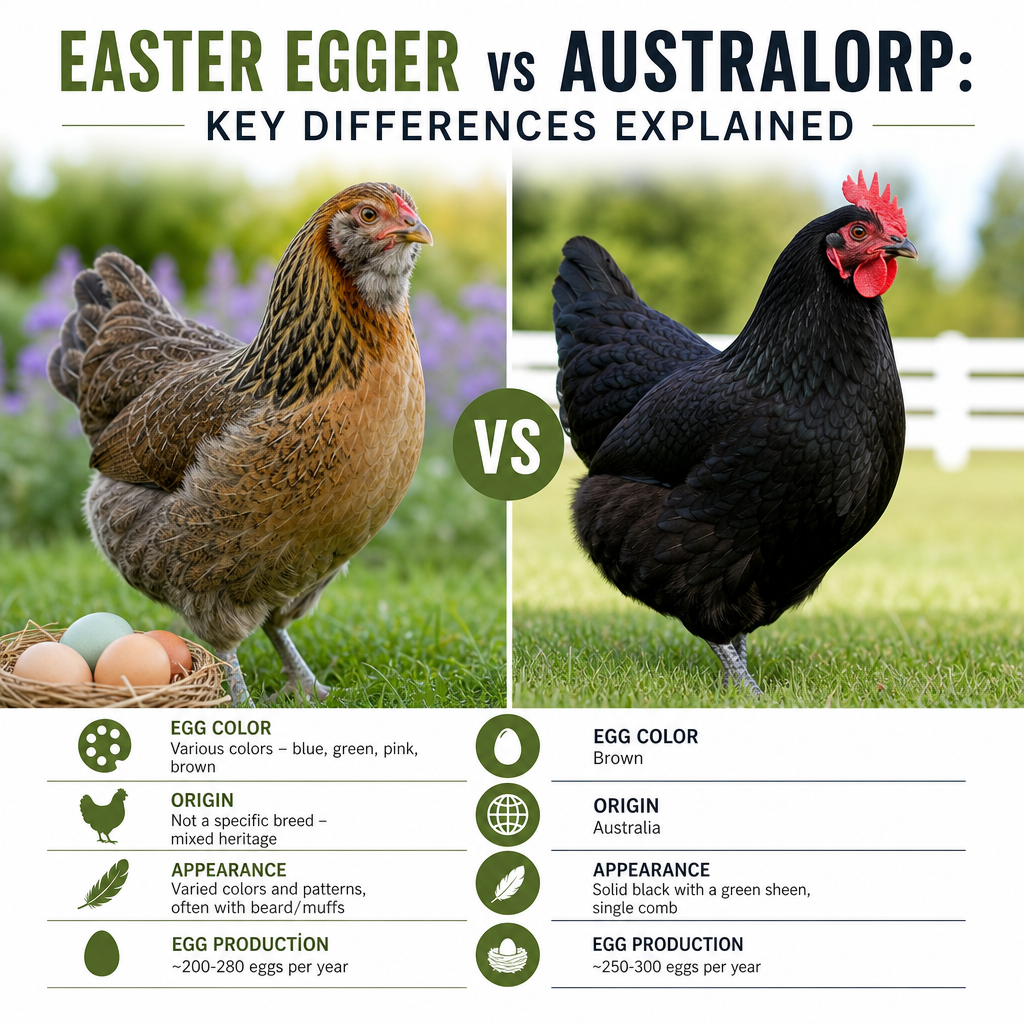
Choosing between an Easter Egger and an Australorp is a common decision for backyard chicken keepers. Both are popular, beginner-friendly birds with strong reputations for egg production, good temperaments, and adaptability. Yet they are not the same type of chicken, and the differences matter if your priorities include egg color, flock personality, climate tolerance, appearance, broodiness, or predictability.
At a glance, Easter Eggers are best known for laying colorful eggs—often blue, green, or olive shades—and for their unique, variable appearance. Australorps are known for consistent brown egg production, calm behavior, and a well-established breed standard. One is a hybrid type with more variation; the other is a recognized pure breed with more consistency.
Understanding those distinctions helps you choose the right bird for your coop, your goals, and your management style.
What Is the Difference Between an Easter Egger and an Australorp?
The biggest difference in the Easter Egger vs Australorp comparison is that an Easter Egger is not a standardized breed, while an Australorp is.
Easter Egger Overview
An Easter Egger is typically a mixed-breed chicken that carries the blue egg gene, often inherited from Ameraucana- or Araucana-type ancestry. These birds are called “Easter Eggers” because they can lay eggs in a range of shell colors, giving the egg basket a colorful, Easter-like appearance.
Because they are not a standardized breed, Easter Eggers can vary widely in:
- Feather color and pattern
- Comb type
- Leg color
- Body size
- Beard and muff presence
- Temperament
- Egg color shade
That variability is part of their appeal, but it also means you get less predictability.
Australorp Overview
The Australorp is a recognized chicken breed developed in Australia, originally from Black Orpington stock. It was selectively bred for utility, especially egg production. Australorps are especially well known for being prolific brown egg layers and for their calm, manageable temperament.
Unlike Easter Eggers, Australorps are relatively consistent in:
- Body shape
- Feather color, especially in black Australorps
- Egg shell color
- Mature size
- Temperament tendencies
- Production characteristics
For keepers who want a reliable and uniform flock, that consistency is a major advantage.
Breed History and Background
Understanding breed origin helps explain why these birds behave and produce differently.
The History of Easter Eggers
Easter Eggers come from crossing blue-egg genetics into non-standardized lines. They are often created by mating Ameraucana or Araucana-related birds with other breeds. The result is a chicken that may carry the blue egg gene but does not meet the strict standards of a recognized breed such as the Ameraucana.
Many hatcheries sell Easter Eggers because they are hardy, visually interesting, and attractive to families who want colored eggs without the higher cost or stricter characteristics of pure Ameraucanas.
The History of Australorps
Australorps were developed in Australia in the late 19th and early 20th centuries. They descend largely from Orpingtons imported from England, but Australian breeders selected them intensively for productivity. The breed became famous for exceptional laying records, and it remains one of the most respected utility breeds in poultry keeping.
The black Australorp is the most common variety, though other colors exist in some regions. In many backyard flocks, when people say “Australorp,” they are referring to the black Australorp.
Appearance: How Easter Eggers and Australorps Look
Appearance is one of the most obvious differences between these birds.
Easter Egger Appearance
Easter Eggers are highly variable. Common features include:
- Beards and muffs
- Pea combs
- Mixed plumage colors
- Slate, willow, or greenish legs
- Tails of varying shape and length
- Small to medium body size
No two Easter Eggers may look quite the same. One may be gray and white with feathered cheeks, while another may be red, black, or buff with an entirely different body profile.
This unpredictability appeals to keepers who enjoy visual variety in the flock.
Australorp Appearance
Australorps have a more defined and recognizable appearance. The black variety typically has:
- Glossy black feathers with a green sheen
- A single upright comb
- Red wattles and earlobes
- Dark eyes
- Clean legs, usually dark or slate-colored
- A broad, deep body
Australorps look more uniform and substantial than most Easter Eggers. They often appear heavier, more rounded, and more traditionally “dual-purpose” in type.
Egg Production: Which Lays Better?
Egg production is often the deciding factor in the Easter Egger vs Australorp debate.
Easter Egger Egg Production
Easter Eggers are generally good layers, though production varies by line. Many hens lay around 180 to 250 eggs per year, but actual output depends on genetics, nutrition, season, stress, and management.
Their main appeal is egg color. Easter Eggers can lay:
- Blue eggs
- Green eggs
- Olive eggs
- Occasionally pink-tinted or cream-tinted eggs
It is important to note that each hen lays only one color consistently. A single hen will not switch randomly between blue and green. However, across a flock of Easter Eggers, you may get a range of shell colors.
Australorp Egg Production
Australorps are often considered better for consistent production. Many hens lay about 250 to 300 eggs per year, and some lines can perform even more impressively under ideal conditions.
Australorp eggs are usually:
- Light brown to medium brown
- Medium to large in size
- Relatively consistent in shape and shell quality
If your main goal is dependable, steady egg output, Australorps usually have the edge over Easter Eggers.
Egg Color: The Most Noticeable Difference
For many chicken keepers, egg color is central to the decision.
Easter Egger Egg Color
Easter Eggers are associated with colorful egg baskets. The blue egg gene changes the shell color throughout the shell, while brown overlay can create green or olive shades. Depending on ancestry, an Easter Egger hen may lay:
- Sky blue
- Aqua
- Mint green
- Olive green
This makes them especially attractive to hobbyists who value variety.
Australorp Egg Color
Australorps lay brown eggs. While the exact shade can vary somewhat from hen to hen, you should expect a conventional brown egg rather than a colored egg.
If egg color novelty matters most, Easter Eggers are the clear winner. If consistency matters more than novelty, Australorps offer reliable brown eggs.
Temperament and Handling
Temperament matters just as much as production, especially in backyard flocks with children or mixed breeds.
Easter Egger Temperament
Easter Eggers are often friendly, curious, and alert, but because they are mixed-type birds, personality can vary significantly. Some are very social and affectionate, while others are more independent or flighty.
Common temperament traits include:
- Curious behavior
- Moderate friendliness
- Active foraging
- Some wariness compared to heavier breeds
- Good flock integration in many settings
You may find that Easter Eggers are entertaining and personable, but not always as predictably calm as Australorps.
Australorp Temperament
Australorps are widely known for being calm, gentle, and easy to handle. They are often recommended for beginners because they tend to be:
- Docile
- Quiet
- Steady in temperament
- Tolerant of confinement
- Friendly toward humans
Many Australorps do well in family flocks and mixed flocks because they are generally non-aggressive and not overly nervous.
In most cases, Australorps are the more predictable choice if your priority is a calm flock.
Noise Level and Flock Behavior
Backyard keepers in suburban areas often need birds that are manageable in close-quarter environments.
Easter Egger Behavior
Easter Eggers are usually moderately vocal. They are active birds and may be more alert and expressive than heavier, more sedate breeds. Their level of noise often depends on the individual bird and the flock environment.
Because they can be somewhat energetic, they often enjoy ranging and exploring. In small runs, they may remain healthy, but they generally benefit from enrichment and space.
Australorp Behavior
Australorps are usually quieter and more settled. They adapt well to both free-range systems and confinement, provided they have adequate space, nutrition, and stimulation.
Their calmer nature often makes them easier to manage in urban or suburban backyard settings where low drama and lower noise are preferred.
Size and Body Type
Body size influences feed intake, handling, predator vulnerability, and dual-purpose value.
Easter Egger Size
Easter Eggers are usually medium-sized birds, though size can vary due to mixed genetics. Typical mature weights often fall around:
- Hens: 4 to 6 pounds
- Roosters: 5 to 7 pounds
Some Easter Eggers are relatively light-bodied and agile, while others are closer to dual-purpose size.
Australorp Size
Australorps are larger and more uniformly built. Mature weights are commonly around:
- Hens: 6 to 8 pounds
- Roosters: 8 to 10 pounds
Their broader bodies and more substantial frame give them stronger dual-purpose value than many Easter Eggers.
Hardiness and Climate Tolerance
Climate suitability is an important factor when selecting a breed.
Easter Egger Hardiness
Easter Eggers are generally hardy birds, especially because hatchery hybrid vigor often contributes to resilience. Many have pea combs, which can reduce the risk of frostbite in cold climates. They often perform well in varied environments, though exact hardiness depends on the individual line.
Strengths often include:
- Good cold tolerance, especially with small combs
- Solid foraging ability
- General adaptability
In hot climates, their performance depends on body size, shade, ventilation, and access to cool water.
Australorp Hardiness
Australorps are also considered hardy and adaptable. They tolerate a wide range of conditions and are known for remaining productive in many backyard systems.
Their strengths include:
- Good general hardiness
- Strong adaptability
- Calm behavior under routine management
However, the large single comb of a black Australorp can be more susceptible to frostbite in severe cold if housing is damp or poorly ventilated. In hot climates, their dark feathers and heavier build mean they need careful heat management, including airflow and shade.
Broodiness and Mothering Ability
Not every keeper wants broody hens, but for those interested in hatching chicks naturally, broodiness matters.
Easter Egger Broodiness
Easter Eggers can go broody, but they are not especially known for consistent broodiness. Some hens make attentive mothers, while others show little interest in setting.
Because Easter Eggers are not standardized, mothering tendencies vary significantly.
Australorp Broodiness
Australorps can also become broody, though they are generally not among the most persistently broody breeds. Still, some lines show decent maternal instincts.
If natural incubation is a major priority, neither Easter Eggers nor Australorps are the top specialized choice compared with more strongly broody breeds. That said, individual hens from either type may do well.
Foraging Ability and Free-Ranging
Easter Eggers as Foragers
Easter Eggers are often excellent foragers. Their alertness, activity level, and mixed background can make them resourceful outdoors. They tend to enjoy ranging and may be more exploratory than heavier utility breeds.
For keepers with pasture, yard space, or orchard systems, this can be a major advantage.
Australorps as Foragers
Australorps also forage well, but they are usually more measured and less active than Easter Eggers. They can free-range effectively and often do very well in backyard systems, but they tend to be less rangy and less flighty.
If you want a highly active flock, Easter Eggers may be more appealing. If you want a calm but still capable free-ranger, Australorps fit that role well.
Feed Efficiency and Maintenance
Feed efficiency can vary by line, environment, and egg output, but some general patterns exist.
Easter Egger Feed Considerations
Because Easter Eggers are often somewhat lighter birds, they may consume less feed than larger dual-purpose hens. However, high activity can offset some of that advantage. Since production varies, feed-to-egg efficiency is less predictable.
Australorp Feed Considerations
Australorps are larger birds and often eat somewhat more than smaller hens, but they convert feed into a very respectable number of eggs. Their reliable production can make them efficient utility birds for households that value steady output.
In practical terms, Australorps often offer a more predictable cost-to-production balance, while Easter Eggers offer more novelty and individual variation.
Breed Standard and Predictability
This is one of the most important but often overlooked differences.
Easter Egger Predictability
When buying Easter Eggers, expect variation. Even from the same hatchery, chicks may mature into adults that differ in:
- Color
- Shape
- Egg shade
- Temperament
- Productivity
That does not mean they are lower quality. It simply means they are less standardized.
Australorp Predictability
Australorps are much more predictable. If you buy Australorps from a reputable breeder or hatchery, you have a much clearer expectation of:
- Adult size
- Feather type
- Egg color
- General temperament
- Production range
For keepers who want to plan carefully and know what they are getting, Australorps are easier to evaluate.
Disease Resistance and General Health
No chicken type is disease-proof, and flock health depends heavily on management, sanitation, biosecurity, genetics, ventilation, and nutrition. Still, both Easter Eggers and Australorps have reputations as generally robust birds.
Easter Egger Health Traits
Easter Eggers are often described as hardy birds with good overall vigor. Their mixed genetics can sometimes contribute to resilience, though this should not be overstated. Some individuals do very well under backyard conditions and adapt readily to changing environments.
Australorp Health Traits
Australorps also have a strong reputation for durability. They are not considered unusually fragile and generally do well in well-managed flocks. Their calm demeanor can reduce stress-related issues in some backyard settings.
In either case, overall flock health depends more on husbandry than breed label alone.
Easter Egger vs Australorp for Beginners
Both are good choices for new chicken keepers, but they suit slightly different goals.
Why Beginners Like Easter Eggers
Beginners often choose Easter Eggers because they offer:
- Colorful eggs
- Unique appearance
- Hardy constitutions
- Engaging personalities
- A fun, varied flock aesthetic
They are especially popular in family flocks where visual interest is part of the enjoyment.
Why Beginners Like Australorps
Beginners often choose Australorps because they provide:
- Calm temperaments
- Reliable laying
- Easy flock management
- Consistent size and behavior
- Strong all-around utility
For a first flock focused on dependable performance and low stress, Australorps are often the safer choice.
Which Breed Is Better for Families With Children?
If children will handle the birds regularly, temperament is critical.
Australorps usually have the advantage because they are more consistently calm and less likely to be skittish. Their gentle nature makes them easier for inexperienced handlers.
Easter Eggers can also make excellent family birds, but there is more individual variation. Some are exceptionally friendly; others are more independent or quick-moving.
If selecting Easter Eggers for a child-friendly flock, it is especially important to choose from a source known for temperament and to handle the birds frequently from a young age.
Rooster Considerations
Although many backyard keepers focus on hens, roosters matter in breeding flocks and temperament planning.
Easter Egger Roosters
Easter Egger roosters can vary widely in both appearance and personality. Some are calm and protective; others may be more reactive or assertive. Because of mixed genetics, there is less consistency in behavior.
Australorp Roosters
Australorp roosters are often described as relatively manageable compared with more aggressive breeds, though any rooster can become territorial. They tend to reflect the breed’s generally steady temperament better than the more variable Easter Egger type.
As always, rooster behavior depends on genetics, handling, maturity, and flock structure.
Meat Value and Dual-Purpose Use
Though many backyard flocks are kept primarily for eggs, body type still matters.
Easter Egger Dual-Purpose Value
Most Easter Eggers are better regarded as backyard laying birds than as true dual-purpose chickens. Their body size and frame are too variable to make them a uniformly strong meat bird choice.
Australorp Dual-Purpose Value
Australorps have better dual-purpose credentials. Their larger frame and solid body shape make them more practical if you want a breed that can contribute both eggs and table value.
Even for non-meat households, that larger body type often translates into a sturdier presence in the flock.
Housing and Space Needs
Both Easter Eggers and Australorps need the standard essentials of good chicken keeping: dry housing, strong ventilation without drafts, safe roosts, nest boxes, clean bedding, and predator security. Still, there are slight differences in how they use space.
Easter Egger Space Use
Because Easter Eggers are often active and inquisitive, they benefit from:
- Space to roam
- Environmental enrichment
- Access to outdoor areas
- Perches and structures for exploration
They can do well in secure runs, but they are often happiest when they can forage and investigate.
Australorp Space Use
Australorps are generally more content in structured backyard settings. They still need adequate space, but they are often more tolerant of confinement than a more active Easter Egger.
This makes them a practical option for keepers with smaller but well-managed runs.
Common Misunderstandings
Several misconceptions often come up in the Easter Egger vs Australorp discussion.
“Easter Eggers lay multiple egg colors.”
Not exactly. Each hen lays one egg color consistently, though the shade may vary slightly over time. A flock of Easter Eggers produces variety, not a single hen changing colors every day.
“Easter Eggers are a recognized breed.”
In most contexts, no. They are a mixed-type chicken that carries blue egg genetics, not a standardized breed like the Australorp.
“Australorps are only good for eggs.”
Not at all. While they are excellent layers, they also have strong dual-purpose qualities and calm flock behavior.
“All Easter Eggers have beards and pea combs.”
Many do, but not all. Their traits vary depending on ancestry.
How to Choose Between Easter Egger and Australorp
The better chicken depends entirely on your priorities.
Choose Easter Eggers if you want:
- Blue or green eggs
- A colorful egg basket
- Individual,